

Lead image: AI-generated conceptual illustration; not a real project, product test or installation specification.
AI-assisted research synthesis; not personally tested or professionally reviewed. Individual authorship and qualified review have not been established. This planning guide does not replace project-specific professional advice.
On this page
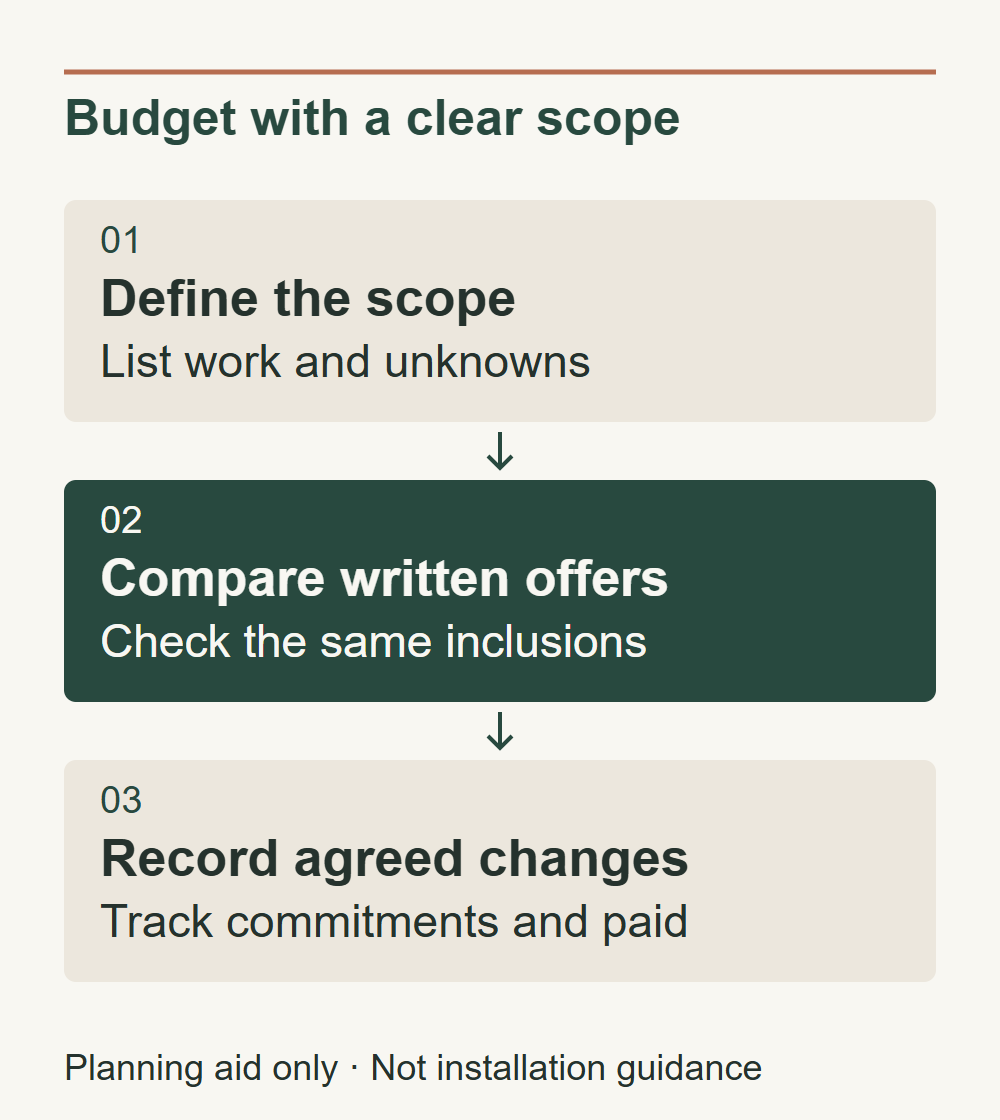
A useful renovation budget records what you intend to buy, what your quotes actually include, and which decisions are still unresolved. Start with scope, compare like-for-like offers, and track commitments as well as payments. A single headline total cannot do those jobs.
This guide is a planning method for U.S. homeowners, not a forecast of local renovation prices, lending advice or a contract review. It contains no market-rate allowances. Your project team and relevant local authority must confirm project-specific requirements before you commit to work.
Start with a scope you can describe
Write a short project statement before collecting prices: which rooms are involved, what should work better afterward, what you intend to retain, and what is outside the job. Separate an essential repair from a preferred finish. A plan to replace worn cabinets while keeping the layout is a different purchase from a plan to move appliances, services and walls.
Build three lists: included work, excluded work and unanswered questions. Give every unresolved question an owner. If you do not know whether an existing surface can remain, record that uncertainty rather than treating reuse as a guaranteed saving. Ask what information would settle the decision and whether the investigation itself needs an agreed scope.
The FTC recommends multiple written estimates describing work, materials, timing and price. Ask for comparable scopes. This guide’s worksheet structure is an editorial organizing method, not a government-prescribed form.
Build a scope-based worksheet
Create a row for each meaningful purchase or work package. Use descriptions that distinguish supply from installation. “Flooring” is less useful than separate rows for the selected floor covering, preparation, fitting and agreed disposal. Break work into detail only as far as you can check it; an invented quantity gives false precision.
| Budget field | What to record | Question it answers |
|---|---|---|
| Scope and specification | Work package, product or agreed performance | What am I purchasing? |
| Quantity and unit | Measured quantity and its basis | Does the quote cover the same amount? |
| Price status | Quote, accepted contract or unpriced item | How firm is this figure? |
| Inclusions and exclusions | Preparation, delivery, disposal and relevant charges | What sits outside the stated amount? |
| Owner and decision date | Responsible person and next action | Who resolves the uncertainty? |
| Committed and paid | Accepted amount and payments made | What remains to be paid? |
Do not add a supply-only quote to an installed price without removing the overlap. Similarly, a contractor’s allowance and your selected item may describe the same purchase. Ask for a reconciliation before adding both. Keep the original quote alongside your summary so the worksheet remains traceable.
Use the budget worksheet for your own unit costs, quantities and contingency assumption. Its subtotal is arithmetic, not independent validation of a bid. Download the CSV before leaving: the worksheet does not retain your figures between visits. Keep signed contracts and payment records separately.
Compare offers before choosing a total
Send each candidate the same current scope and drawings. Identify differences in preparation, who buys products, access arrangements, protection, cleanup and completion responsibilities. Ask the contractor to explain exclusions in ordinary language. Record the answer against the quote rather than relying on a conversation you may remember differently later.
For an item marked “allowance,” ask what purchase it covers, how the actual selection will be reconciled and which associated work is priced separately. For an unpriced task, ask whether a defined investigation or design decision can establish its scope. Do not silently substitute another contractor’s figure into an offer that excludes the task.
The FTC advises checking licensing and insurance and notes that contract requirements vary by state. New York City’s consumer guidance provides local estimate, contract and change-order resources; those rules are not national rules. Have applicable terms checked locally.
Make uncertainty visible
Keep a risk register beside the worksheet. For each unresolved condition, write what might change, what is known, what investigation is proposed, and who must authorize additional work. Examples of questions include whether concealed damage exists, whether a chosen item is available, and whether access or approved scope could change. These are prompts to investigate, not predictions that your home has those problems.
Choose any contingency assumption deliberately with your project team. This article does not prescribe a universal percentage. Do not use a contingency line to make an incomplete base scope appear complete. Keep optional upgrades separate from the reserve for unresolved work so you can see which decisions consume flexibility.
If the total is beyond your limit, revise scope openly. Ask for distinct options with a clear description of what each removes or postpones. Recheck dependencies before deferring a task: your designer or contractor should explain whether later work would disturb completed finishes. Record the implications instead of assuming that every phase can be separated cleanly.
Track commitments, changes and cash timing
A budget can look healthy while the next payment arrives before you expected it. Build a dated payment view from the proposed contract and orders. Identify deposits, agreed progress payments, delivery-related charges and the remaining balance without inventing a standard payment schedule. Check applicable consumer protections with the relevant local agency before agreeing to terms.
For each proposed change, record the original scope, requested revision, price effect, schedule effect and approval status. Keep a running approved total and a separate list of proposals awaiting a decision. Ask how unused allowances or removed work will be credited. Do not treat an unapproved proposal as paid or assume a verbal discussion settled its terms.
Finish with records you can use
At handover, reconcile accepted changes, credits and payments against the final scope. Keep actual product details, relevant approvals, warranties and maintenance documents together. Ask your project team to explain outstanding items and the agreed process for resolving them. The practical goal is a record of what was purchased and delivered, not merely a spreadsheet that balances.
Return to Planning & Costs for the broader collection and use the project checklist to track decisions. Within this draft batch, related contractor, room and materials guides remain unapproved; they are not linked as if already published.
Sources & editorial context
Sources were retrieved for this draft on 2026-10-24. Retrieval verifies access and the cited passage, not comprehensive factual accuracy or qualified approval. Original planning frameworks are editorial synthesis. No interviews, product tests or first-hand renovation experience are claimed.
How To Avoid a Home Improvement Scam — Federal Trade Commission. Publication: 2022-07; update: not stated; accessed: 2026-10-24.
Quick Tips When Hiring a Home Improvement Contractor — NYC Department of Consumer and Worker Protection. Publication: not stated; update: 2026-06; accessed: 2026-10-24.
Required review: Local consumer-contract, payment and permit responsibilities; human factual edit. Individual authorship and qualified review have not been established. The illustrations and diagrams are conceptual media, not real-project evidence. The publication date does not imply a professional fact-check.
Stored only in this browser on this device. Clearing browser data removes your progress. No account or tracking.