
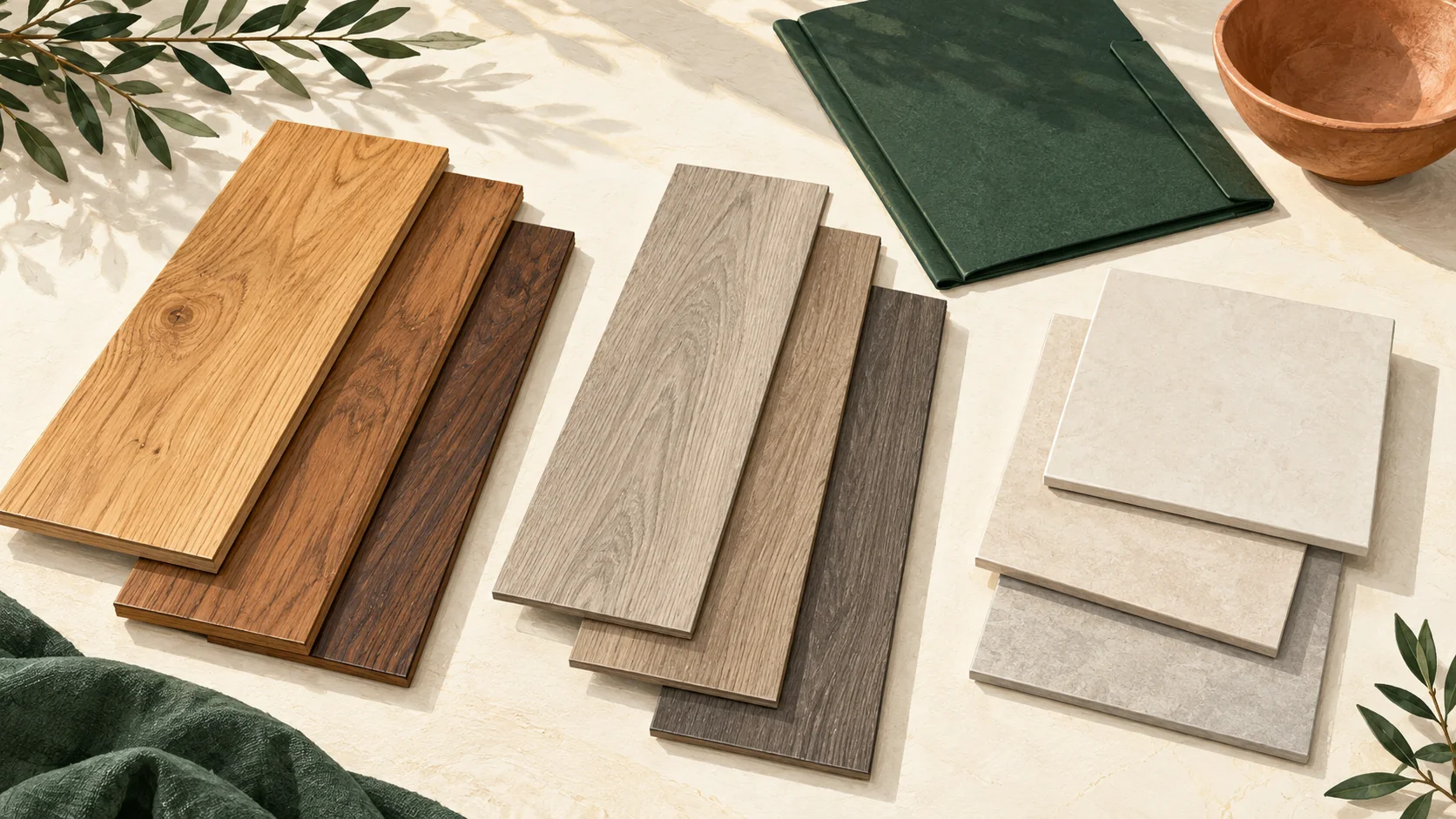
Lead image: AI-generated conceptual illustration; not a real project, product test or installation specification.
AI-assisted research synthesis; not personally tested or professionally reviewed. Individual authorship and qualified review have not been established. This planning guide does not replace project-specific professional advice.
On this page
- Define the room before comparing samples
- Understand what the product description means
- Compare the evidence you need
- Separate water-related claims from the full assembly
- Consider repair and maintenance as purchasing questions
- Compare complete installed scopes
- Make the selection traceable
- Sources & editorial context
Choose flooring by comparing actual products in the room where they will be used. Start with moisture exposure, the existing base, household needs, installation scope and the maintenance you are prepared to undertake. A sample’s appearance matters, but a material name alone cannot establish suitability.
This guide compares decision criteria, not tested or ranked products. It supplies no price ranges, lifespan promises, universal “best floor” verdict or installation instructions. A qualified installer or designer must verify the selected product and assembly for your building and applicable requirements.
Define the room before comparing samples
Write down what the room needs to tolerate and how it connects to neighboring spaces. Include expected use, spills, cleaning, furniture movement, pets or mobility aids where relevant. Describe actual access needs rather than assuming that one material category automatically meets them.
Record the known base, existing floor layers and any visible condition concerns without disturbing them. Ask the installer what assessment and preparation are required. The finished floor height, transitions, door operation and access to fittings are coordination questions to settle before purchase, not details to improvise after installation.
If existing flooring or adhesive is suspect, stop before removal. EPA explains that disturbance of asbestos-containing construction materials can release fibers. A product comparison is not a method of identifying hazardous materials or permission to remove them. Have the appropriate professional assess that question first.
Understand what the product description means
The National Wood Flooring Association distinguishes solid and engineered real-wood flooring: solid boards are a single piece, while engineered products use layers. Treat refinishing potential as a product-specific question rather than assuming that every engineered floor can be repeatedly sanded. Ask the supplier for the selected product’s documented limits.
Luxury vinyl plank is not one installation system. RFCI describes flexible LVT/LVP installation categories including glue-down, floating and loose-lay, and lists rigid-core flooring separately. Its trade-association descriptions are product-category background, not independent comparative testing. Obtain the instructions for the exact construction you are considering.
For tile, obtain the intended-use and installation documentation rather than relying on the words ceramic or porcelain. TCNA describes ANSI A326.3 as a hard-surface flooring friction test and use-classification standard. Ask the specifier to interpret the selected product’s documented classification for the intended location. This guide does not declare any floor slip-proof or prescribe a universal threshold.
Compare the evidence you need
| Decision | Hardwood candidate | LVP candidate | Tile candidate |
|---|---|---|---|
| Product identity | Solid or engineered construction and finish | Flexible or rigid construction and installation method | Exact tile, finish and documented intended use |
| Moisture suitability | Product limits and site assessment | Product, seams, perimeter and substrate requirements | Complete assembly and wet-location requirements |
| Installation scope | Base preparation and manufacturer requirements | Base preparation, adhesives or underlayment as specified | Support, preparation and selected installation system |
| Repair plan | Documented repair or refinishing options | Replacement method for the chosen system | Replacement method and matching-material availability |
| Care | Instructions for the actual finish | Approved cleaning and product limitations | Tile, grout and any sealer care requirements |
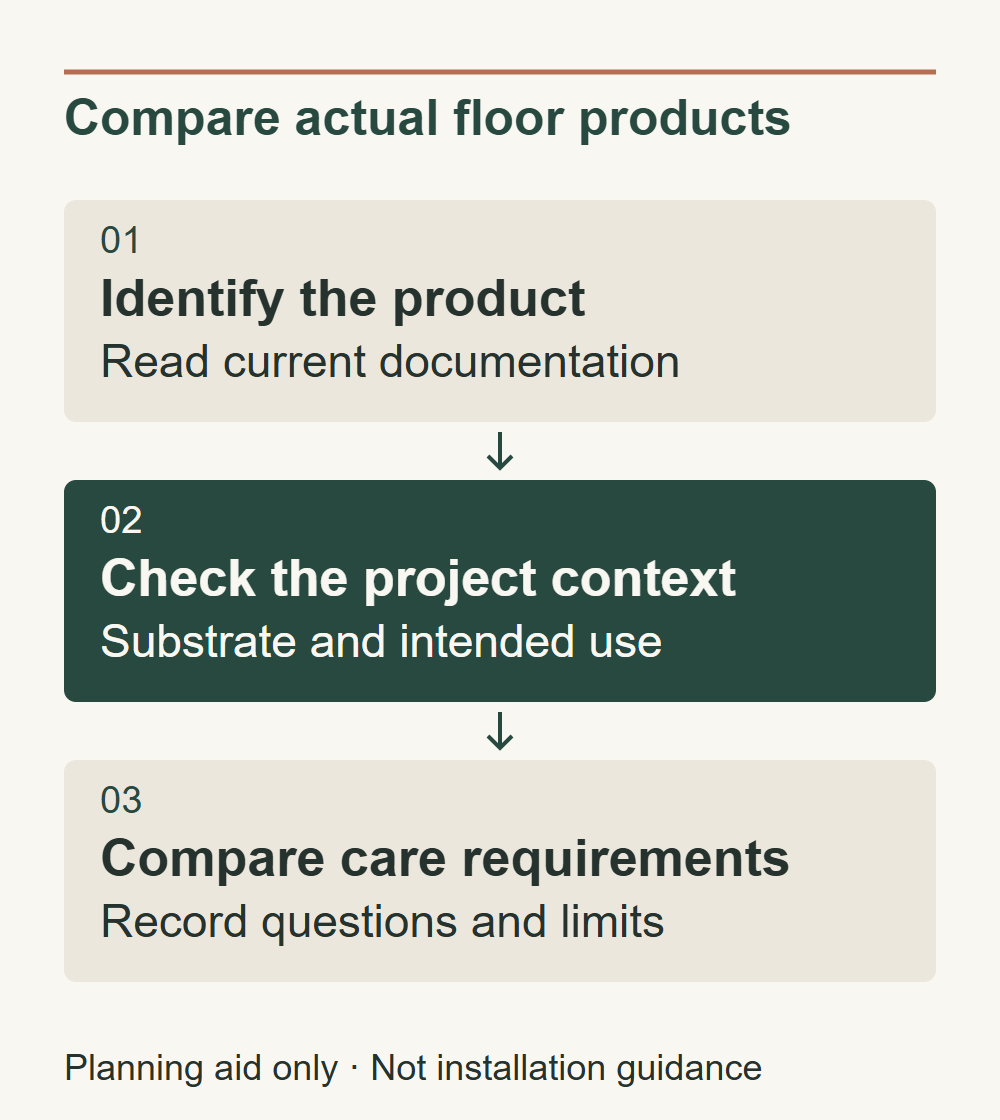
The table is a checklist of questions, not performance scores. Fill it with product documents and a site-specific assessment. If a supplier cannot substantiate a claimed advantage, mark it unresolved rather than converting marketing language into a ranking.
Separate water-related claims from the full assembly
Ask precisely what a “waterproof” or “water-resistant” claim covers. Does it refer to a product component, a defined test, a particular use, or the installed system under specified conditions? Request the written limitation and warranty rather than assuming that a surface claim protects everything beneath it.
Have the responsible installer assess moisture and base conditions using the methods appropriate to the product and project. Do not choose a test, limit or remediation method from this general comparison. Ask how any identified problem will be resolved before the floor is installed and who will document acceptance of the base.
For a room exposed to water, coordinate the flooring with surrounding construction, penetrations and adjoining rooms. The designer should explain the intended water-management approach. A flooring purchase does not establish the suitability of an entire bathroom, basement or kitchen assembly.
Consider repair and maintenance as purchasing questions
Ask what happens after a scratch, damaged piece or localized spill. Request the actual repair procedure, who can undertake it, any access needed and the consequences for adjacent work. Do not assume the presence of individual planks or tiles makes replacement straightforward in every installation.
Read care instructions before accepting a product. Compare them with the cleaning routine the household can realistically maintain. Ask which products or methods are prohibited, whether any periodic treatment is specified, and where that obligation appears in the warranty. No maintenance interval is prescribed here without the selected product’s documentation.
Check appearance using sufficiently representative samples and the room’s light, with the supplier’s explanation of variation. If possible, discuss how pattern, board or tile layout and transitions would be planned. A small sample is a design aid, not a guarantee that every installed piece will look identical.
Compare complete installed scopes
Request quotes that distinguish the floor covering from investigation, removal where appropriate, preparation, installation, transitions, protection and disposal. Identify owner-supplied items and any exclusions. Do not compare a retail material-only price with another contractor’s completed installation scope.
Record actual quantities and their measurement basis. Ask how ordering quantities, offcuts, retained spare material and returns are to be handled; this guide does not invent a universal waste percentage. Use the budget worksheet for entered unit costs and quantities while keeping unpriced questions visible.
Make the selection traceable
Before ordering, assemble the product identifier, current instructions, agreed installation scope, condition findings, finish sample and care requirements. Have the responsible supplier and installer confirm that the documents describe the same product and intended use. Resolve substitutions through that same process instead of treating a visually similar option as equivalent.
At handover, collect the final product and care records, relevant warranties and an agreed list of outstanding issues. Your decision should be explainable in terms of the room’s needs and documented product suitability, rather than an unsupported claim that one material is always superior.
Continue with Materials & Finishes, Interiors & Living and Bathroom Renovations. Future comparisons and room guides remain editorial drafts until reviewed and approved.
Sources & editorial context
Sources were retrieved for this draft on 2026-10-24. Retrieval verifies access and the cited passage, not comprehensive factual accuracy or qualified approval. Original planning frameworks are editorial synthesis. No interviews, product tests or first-hand renovation experience are claimed.
Asbestos’ Impact on Indoor Air Quality — U.S. Environmental Protection Agency. Publication: not stated; update: 2026-01-13; accessed: 2026-10-24.
Types of Wood Floors — National Wood Flooring Association. Publication: not stated; update: not stated; accessed: 2026-10-24.
Flexible LVT/LVP — Resilient Floor Covering Institute. Publication: not stated; update: not stated; accessed: 2026-10-24.
Dynamic Coefficient of Friction — Tile Council of North America. Publication: not stated; update: 2025-08-01; accessed: 2026-10-24.
Required review: Qualified flooring specification, substrate/moisture assessment, hazardous-material and accessibility review. Individual authorship and qualified review have not been established. The illustrations and diagrams are conceptual media, not real-project evidence. The publication date does not imply a professional fact-check.
Stored only in this browser on this device. Clearing browser data removes your progress. No account or tracking.