

Lead image: AI-generated conceptual illustration; not a real project, product test or installation specification.
AI-assisted research synthesis; not personally tested or professionally reviewed. Individual authorship and qualified review have not been established. This planning guide does not replace project-specific professional advice.
On this page
- Define a bounded task
- Identify hazards before comparing convenience
- Use a decision table with stop points
- Compare the full scope of effort and expense
- Consider a clearly divided project
- If you hire, verify the actual person and scope
- Make an explicit decision and revisit it when facts change
- Sources & editorial context
Decide whether to do a task yourself by defining the task and its consequences first. Consider what could go wrong, what you can actually verify, which permissions apply and who will take responsibility if conditions change. Confidence, a short video and a tempting labor saving are not a complete assessment.
This guide is a U.S. homeowner planning framework. It does not certify competence, determine permit requirements or provide procedures for hazardous work. It is not a professional safety review, and no list here can assess your house remotely.
Define a bounded task
Describe the proposed work as a specific outcome with a start and finish. Separate making a design choice or measuring an accessible space from removing a material, altering a service or changing structure. A broad label such as “bathroom refresh” can hide several different tasks requiring different responsibilities.
Write what is known about the existing condition and what remains uncertain. Identify what information you would need before starting, who can establish it safely and what would change the scope. If the first step requires disturbing an unknown material or opening an unfamiliar system, stop the planning exercise there and obtain appropriate assessment.
Think beyond the visible finish. Ask who will protect adjacent areas, manage access, handle waste appropriately and verify completion. These questions help compare the whole responsibility rather than treating an installed contractor price as a payment for hands-on labor alone.
Identify hazards before comparing convenience
EPA’s lead-safe renovation guidance recommends lead-safe certified contractors for projects involving lead paint in pre-1978 homes. It explains that the federal rule’s application to owner work differs from situations such as rentals, child care and renovating for sale. That distinction is not permission to disturb paint without a safety plan; local requirements also need checking.
EPA also warns that disturbing asbestos-containing building materials can release fibers. Do not use appearance, a guess about age or this article to declare a material safe. Have the appropriate professional determine whether investigation or specialist handling is needed before work proceeds.
Other questions for qualified assessment include electrical or fuel systems, structural changes, roof or other fall exposure, and water-management assemblies. This guide deliberately does not classify a specific wiring, plumbing or roof task as safe for a reader to attempt. The actual condition, legal permissions and required competence must be established first.
Use a decision table with stop points
| Question | Evidence you need | If it remains unresolved |
|---|---|---|
| Do I understand the exact task? | Defined scope and current product instructions | Refine the scope before purchasing |
| Are existing conditions known? | Appropriate assessment, not a visual guess | Arrange qualified investigation |
| Which permissions apply? | Confirmation from the relevant authority | Do not assume an exemption |
| Can I perform and verify it competently? | Relevant skills and a credible verification plan | Seek the responsible qualified trade |
| Can I protect other occupants and adjacent work? | An appropriate protection and access plan | Resolve the plan before starting |
| What triggers a stop? | Named uncertainties and a contact for escalation | Do not improvise beyond the agreed task |
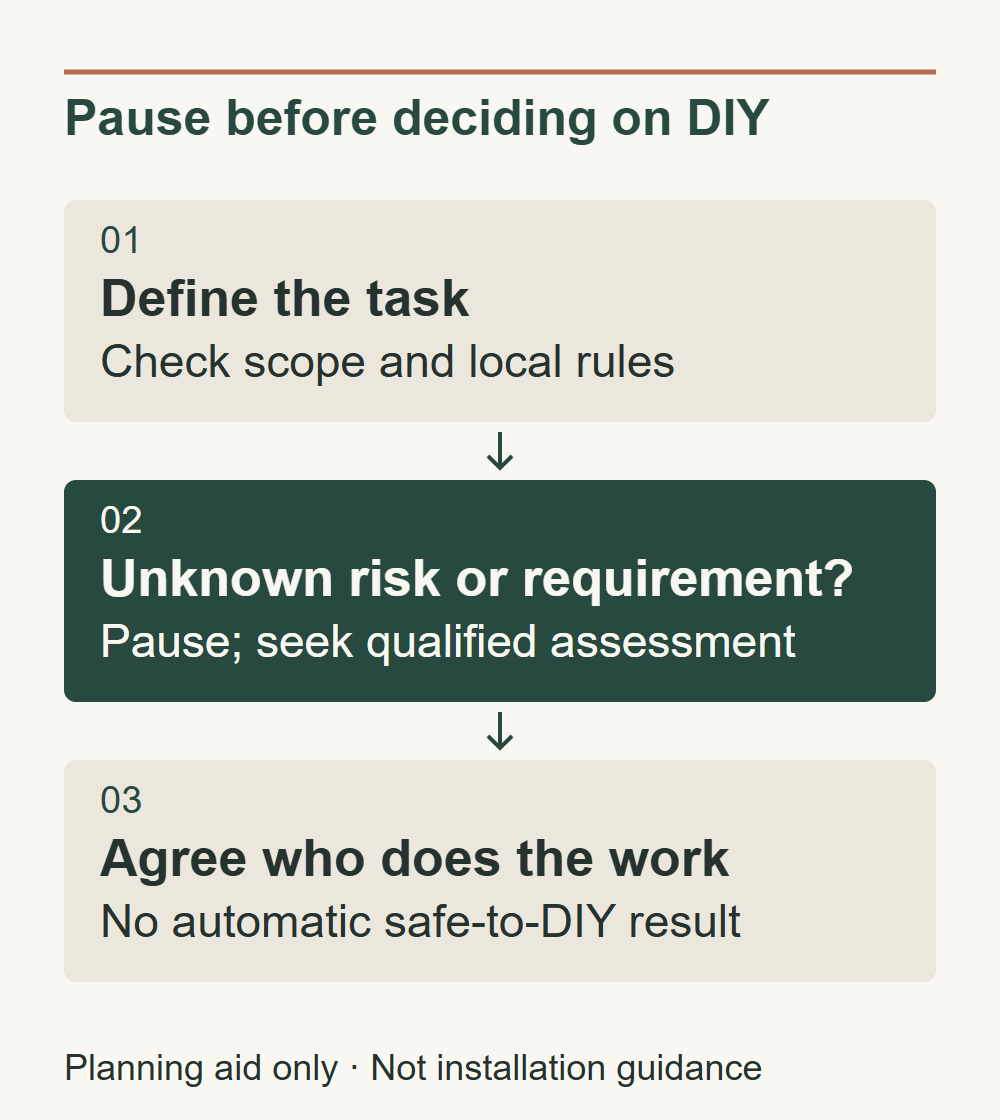
The table is a decision aid, not a scoring system. Several easy answers do not cancel out a serious unresolved hazard. A task can also be lawful for an owner in a particular location yet remain unsuitable for that person’s skills or circumstances. Ask the local authority and relevant specialist to settle their respective parts of the question.
Compare the full scope of effort and expense
List the materials, tools, access arrangements, protection, waste handling and any assessment the task actually requires. Add your available time and the consequences of a delay, including whether the household loses use of a room. Avoid inventing an hourly value or guaranteed completion time simply to force a comparison.
Request a comparable contractor scope if professional work is an option. Identify what investigation, preparation, finishing, verification and follow-up it includes. If your own plan omits those tasks, the two totals are not describing the same outcome. A lower material bill does not establish the cost or quality of a completed job.
Use your own amounts in the budget worksheet and keep uncertain items unpriced until you can establish a basis. This article makes no claim that DIY saves a particular percentage or that hiring someone guarantees a problem-free result. Responsibility and evidence matter in either route.
Consider a clearly divided project
Some homeowners may choose to undertake defined, agreed tasks while hiring professionals for other parts. Discuss that division before signing or starting. Ask the contractor and relevant authority whether your proposed involvement affects sequencing, acceptance of previous work, warranty terms or inspection responsibilities.
Record who supplies each item, who checks it and where responsibility changes hands. Do not assume that someone hired later will certify earlier work they did not assess. If the project team cannot agree on a clear boundary, resolve that before treating a split approach as an assured saving.
Set stop points for findings that change the task: an unidentified material, unexpected damage, a service you cannot identify or a result that does not match the product instructions. The response should be to secure the situation appropriately and obtain qualified help, not to extend an unfamiliar procedure through trial and error.
If you hire, verify the actual person and scope
FTC consumer guidance recommends checking required contractor licensing with the state or county, obtaining insurance evidence and comparing written estimates. Apply those checks to the proposed work and the relevant local requirements. A broad title such as “handyman” does not settle what a person is permitted or qualified to do.
Ask how the contractor will document findings, proposed changes and completion. Establish a communication route and the process for authorizing additional work. Have legal or contract questions reviewed by an appropriate adviser rather than relying on a general renovation article to determine your rights.
Make an explicit decision and revisit it when facts change
Write a short decision record: defined task, known limits, selected responsibility, approvals still needed and the event that would stop work. Keep current product instructions and relevant advice with it. If investigation changes the facts, reassess the decision instead of treating the original choice as a commitment to finish at any cost.
Explore DIY & Repairs, Planning & Costs and the project checklist. The separate lead-safe planning brief still requires dedicated research and specialist review before it becomes an approved article.
Sources & editorial context
Sources were retrieved for this draft on 2026-10-24. Retrieval verifies access and the cited passage, not comprehensive factual accuracy or qualified approval. Original planning frameworks are editorial synthesis. No interviews, product tests or first-hand renovation experience are claimed.
Lead-Safe Renovations for DIYers — U.S. Environmental Protection Agency. Publication: not stated; update: 2026-08-20; accessed: 2026-10-24.
Asbestos’ Impact on Indoor Air Quality — U.S. Environmental Protection Agency. Publication: not stated; update: 2026-01-13; accessed: 2026-10-24.
How To Avoid a Home Improvement Scam — Federal Trade Commission. Publication: 2022-07; update: not stated; accessed: 2026-10-24.
Required review: Qualified safety and local-permissions review, including lead/asbestos and trade responsibility; human factual edit. Individual authorship and qualified review have not been established. The illustrations and diagrams are conceptual media, not real-project evidence. The publication date does not imply a professional fact-check.
Stored only in this browser on this device. Clearing browser data removes your progress. No account or tracking.