
Lead image: AI-generated conceptual illustration; not a real project, product test or installation specification.
AI-assisted research synthesis; not personally tested or professionally reviewed. Individual authorship and qualified review have not been established. This planning guide does not replace project-specific professional advice.
On this page
The useful question is not simply how old the roof is. Ask what has failed, how widely the problem extends, whether a proposed repair addresses its cause, and what each option includes. A decision should follow a qualified condition assessment and comparable written scopes, not a photograph or a sales deadline.
This guide helps a U.S. homeowner prepare for that discussion. It does not diagnose a roof, estimate remaining service life, establish insurance coverage or supply repair instructions. There is no universal replacement age, percentage-of-damage rule or market price in this article.
Observe from a safe position
Keep an initial record of what you can see from ground level and from safely accessible indoor areas. Note when a symptom appeared, what weather preceded it, and whether its location or extent has changed. Photographs and previous project records may help a professional understand the history, but they do not establish the concealed condition.
After storms, NRCA advises ground-level observation and professional assessment and repairs. Do not climb onto the roof, move damaged components or attempt temporary repairs to complete this checklist. Access and emergency protection need a competent professional’s assessment.
If you see an immediate danger such as falling material, a visibly unstable area or water near electrical equipment, keep people away and contact the appropriate emergency or qualified service. This guide cannot determine whether a space is safe to occupy. Do not enter an unsafe area to obtain a better photograph.
Build a useful condition history
Collect any available installation records, product information, warranty documents, previous repair scopes and leak history. Note where information is missing rather than filling the gap with an assumed installation date. Describe past work as documented, not as proof that the entire roof was replaced at that time.
Ask the assessor to distinguish the roof covering from associated details and underlying construction. The scope of an investigation should explain what can be observed, what cannot be confirmed without further access, and what evidence supports the recommendation. A finding about one area should not silently become a conclusion about every part of the roof.
Request a clear account of the identified problem, its proposed cause and the consequence of leaving it unresolved. If there are several plausible explanations, ask what would distinguish them. The purpose is to make uncertainty explicit before comparing solutions, rather than to diagnose the source of water yourself.
Compare the reasons for each option
| Option to discuss | Evidence the assessor should explain | Questions still to resolve |
|---|---|---|
| Defined local repair | Identified defect and a repair scope that addresses it | Compatibility, adjacent conditions and limits of the repair |
| Wider repair or partial work | Documented extent and why a smaller repair is insufficient | Interfaces with retained work and responsibilities |
| Replacement | Findings supporting replacement rather than repair | Removal scope, concealed-condition process and complete assembly |
| Further investigation | Specific uncertainty that prevents a reliable recommendation | Investigation method, cost, responsibility and next decision |
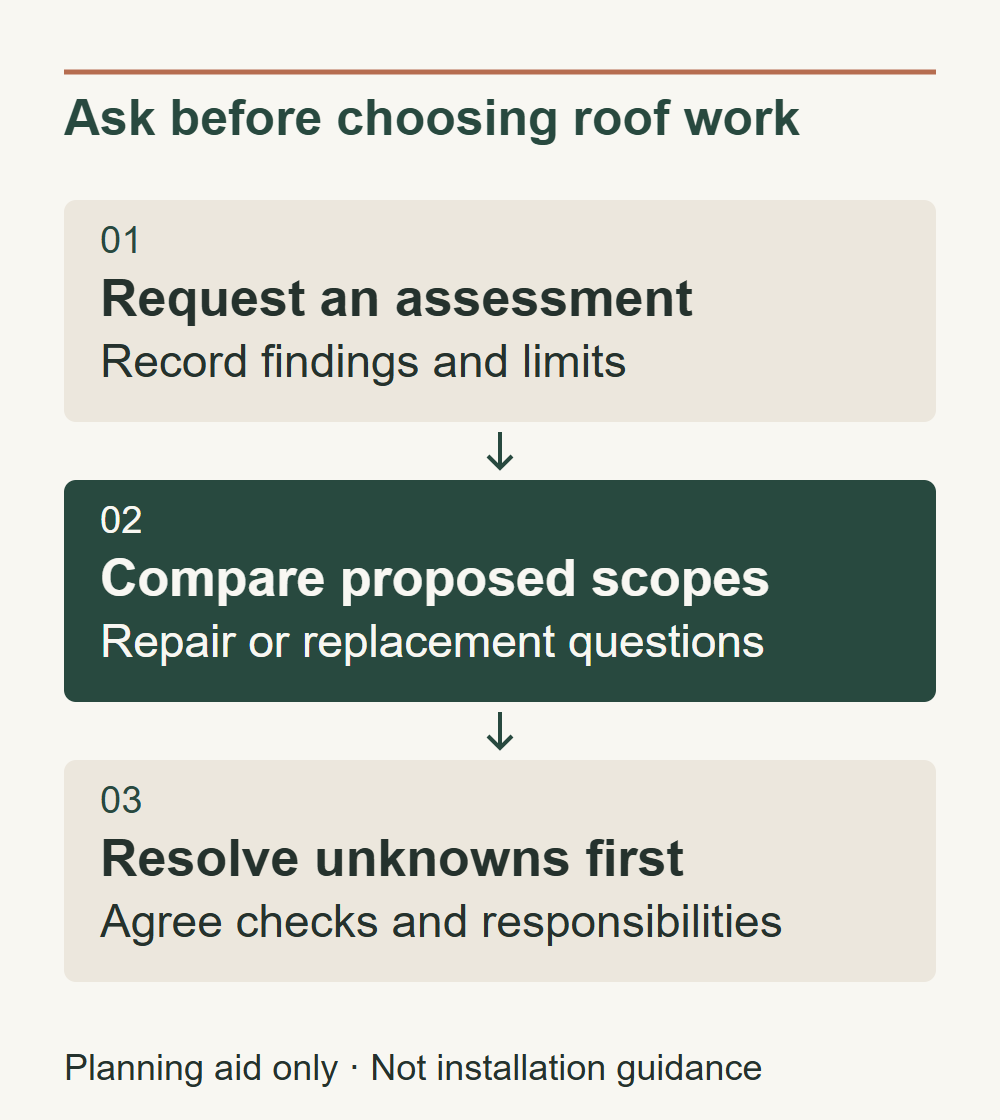
These are discussion categories, not remote diagnoses or universal recommendations. The assessor must explain why an option is suitable for this building. If recommendations differ, ask each contractor to address the same findings and scope rather than treating a cheaper headline number as the same proposal.
Ask how retained and new materials would work together and what current manufacturer requirements apply. Establish whether an option depends on an unverified assumption about underlying construction. Do not assume a replacement automatically fixes every related moisture issue, or that an isolated repair is adequate because it is physically smaller.
Read the entire proposed scope
NRCA’s consumer resources identify useful proposal details including the covering, removal work, flashing, ventilation, installation method, timing and warranty. Ask contractors to make those items explicit and comparable. Product and workmanship warranties are different documents; obtain their actual coverage and exclusions rather than relying on the word “warranty.”
Request the process for unforeseen conditions: who records a finding, who recommends a response, how price and timing changes are authorized, and what happens before the affected work continues. Ask about protection of the building and surroundings, disposal and responsibility for damage during the work.
Confirm relevant permit and inspection responsibilities with the local authority and the appropriate project professionals. Existing roof layers, structural capacity, weather exposure and the selected system may raise questions that this general article cannot answer. No particular reroofing method is authorized by this checklist.
Make a decision with visible trade-offs
Compare options using the documented problem and the limitations of each proposal. Record the amount from each actual quote, the work included, unresolved questions and the professional explanation for the expected outcome. Do not calculate a supposed cost per year by inventing a remaining lifespan.
Consider household constraints as well as the works: access, protection, disruption and decisions needed before an available work window. Ask the contractor to describe weather-related arrangements without treating a provisional schedule as a guarantee. If a recommendation depends on an insurer or another third party, obtain their own explanation of the process; a contractor’s statement is not a coverage determination.
Pressure to decide immediately is a reason to slow the purchasing decision, not evidence that a proposed scope is correct. FTC contractor guidance describes high-pressure selling and demands for full upfront payment as warning signs. Check the relevant credentials and consumer protections in your location, and have contract questions reviewed appropriately.
Plan verification and handover
Agree what records you will receive for the accepted scope: actual products, relevant approvals, documented changes, contractor checks and warranty information. Ask how work that will become concealed is recorded and which inspections are required. Photographs may supplement a record but do not replace the necessary professional or authority checks.
At completion, review the work against the agreement with the responsible contractor. Record outstanding items and the follow-up process. Ask for maintenance instructions appropriate to the installed system, and keep the original condition findings with the completed work record so future professionals can understand the decision.
Explore Exterior Renovations and Planning & Costs. Use your own quote figures in the budget worksheet and track decisions in the project checklist. Drafts about insulation and other envelope work are editorial dependencies, not approved public recommendations.
Sources & editorial context
Sources were retrieved for this draft on 2026-10-24. Retrieval verifies access and the cited passage, not comprehensive factual accuracy or qualified approval. Original planning frameworks are editorial synthesis. No interviews, product tests or first-hand renovation experience are claimed.
Roof Repairs After a Storm — National Roofing Contractors Association. Publication: not stated; update: not stated; accessed: 2026-10-24.
Resources — Roofing Guidelines — National Roofing Contractors Association. Publication: not stated; update: not stated; accessed: 2026-10-24.
How To Avoid a Home Improvement Scam — Federal Trade Commission. Publication: 2022-07; update: not stated; accessed: 2026-10-24.
Required review: Qualified roofing assessment; structural, ventilation, hazardous-material, contract and insurance review where relevant. Individual authorship and qualified review have not been established. The illustrations and diagrams are conceptual media, not real-project evidence. The publication date does not imply a professional fact-check.
Stored only in this browser on this device. Clearing browser data removes your progress. No account or tracking.